When you start learning Qigong you meet a small set of terms, most of them from traditional Chinese medicine, and they can feel like a wall if no one defines them plainly. They are simpler than they look. Here they are, one at a time, each in a sentence or two you can carry with you. You do not need to master any of this to practice. Think of it as a map you glance at, not a test you sit.
Qi
Qi (pronounced chee) is the traditional Chinese word for life energy, the vital force said to flow through every living thing. In Qigong you learn to sense, gather, and move your qi with gentle movement, breath, and attention. You will also see it spelled chi, which is the same word. Whether or not you think of it in traditional terms, most people can feel something real when they slow down and pay attention, a warmth or a fullness that the word qi points to.
The dantian (and the three of them)
A dantian is an energy center in the body where qi is said to gather and store. The word means something close to elixir field, an inner place where vitality is cultivated. Traditionally there are three, stacked from the belly to the head:
- The lower dantian sits in the lower belly, roughly two to three finger widths below the navel and a little inward toward the center of the body. It is the body's main energy reservoir and the place most beginners are taught to breathe into and rest their attention. When people say to breathe into your center, this is the center they mean.
- The middle dantian sits at the chest, around the heart. It is associated with the breath and the emotions.
- The upper dantian sits at the brow, between and slightly above the eyebrows. It is associated with the mind and awareness.
For your first months of practice, you really only need the lower one. Rooting your attention there is the foundation, and the other two come naturally in time.
The meridians
Meridians are the channels through which qi is said to flow through the body, like rivers of energy. Traditional Chinese medicine maps a whole network of them, and it is the same map acupuncture works from. The idea behind Qigong movement and breath is simple: keep the rivers flowing freely so nothing pools or stagnates. When the flow is easy, health tends to look after itself. When it is blocked, you feel it as tension, heaviness, or fatigue. You do not need to memorize the channels. Your job is just to keep the energy moving.
Yin and yang
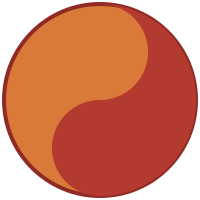
Yin and yang are the two complementary forces that traditional Chinese thought sees at play in everything, always in balance with each other. Yin is the receptive, cool, still, downward quality. Yang is the active, warm, rising, expansive quality. They are not opposites at war. They are two halves of one whole, each defining the other, the way night defines day. In practice this shows up as balance: effort and ease, movement and stillness, gathering energy and releasing it. A good Qigong practice moves between the two rather than pushing only in one direction.
The three treasures
The three treasures are the three fundamental energies of a human being in the Taoist tradition: jing, qi, and shen, often translated as essence, energy, and spirit. A plainer way to hold it is body, heart, and mind. Qigong is a way of caring for all three, and the three dantians map onto them, the lower for the body and its vitality, the middle for the heart, the upper for the mind. We go further into how the Three Treasures map onto the Three Centers, including the part most explanations leave out.
'The art of cultivating great energy is different for the body, for the heart and for the mind. These are the 3 treasures in the Taoist tradition.' Christopher Grant
A short note on how to feel qi
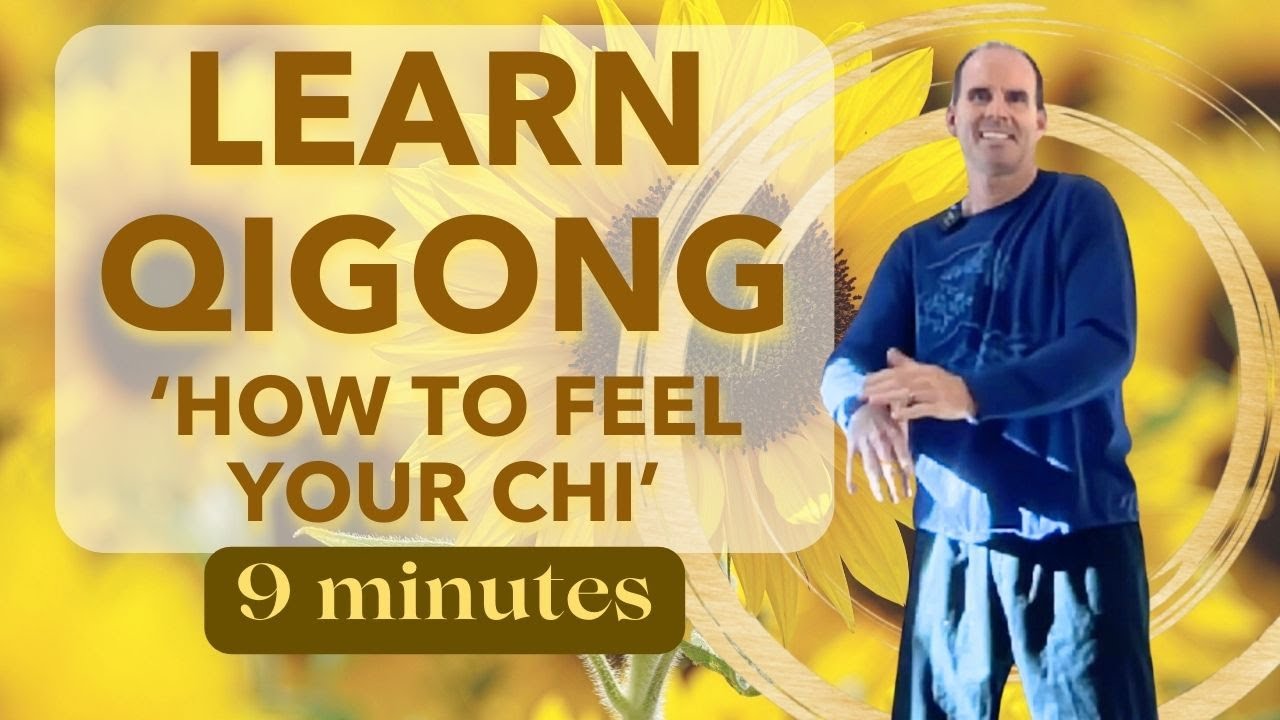
All of these words point at something you can actually experience, and the fastest way to make them real is to feel qi for yourself. Try this. Sit or stand comfortably and rub your palms together briskly for ten seconds or so, until they feel warm. Then hold them a few inches apart, facing each other, and slowly draw them apart and back together, as if you were holding a soft ball of air between them.
Most people notice something: a warmth, a faint tingling, a subtle pressure or magnetic pull between the hands. That sensation is what the word qi is pointing to. It is not exotic and you are not imagining it. It is circulation and attention gathering where you place them, and it is the same feeling you will learn to move around the body in practice. If nothing comes the first time, do not worry. Feeling grows with practice, and it comes more easily on some days than others.
Watch: Learn Healing Qigong with Christopher and Daniela, from our Great Energy YouTube channel.
Where these words come alive
Definitions only take you so far. These terms make sense once you are moving, so if you are ready, read the plain-English overview of what Qigong is, look at the benefits people report, then start with the beginner's guide or a few simple exercises for beginners. If you prefer to learn from a teacher, see the schools and teachers Christopher trained with. Keep this page bookmarked and come back to it whenever a word trips you up.
The three dantian
The twelve primary meridians
| Meridian | Associated organ or system | Element |
|---|---|---|
| Lung | Lungs, skin, breath | Metal |
| Large Intestine | Elimination, letting go | Metal |
| Stomach | Digestion, nourishment | Earth |
| Spleen | Transformation, energy from food | Earth |
| Heart | Circulation, mind, sleep | Fire |
| Small Intestine | Sorting, clarity | Fire |
| Bladder | Fluids, the back line of the body | Water |
| Kidney | Deep reserves, will, bones | Water |
| Pericardium | Protecting the heart | Fire |
| Triple Burner | Regulating warmth and fluids | Fire |
| Gallbladder | Decisions, the sides of the body | Wood |
| Liver | Smooth flow of energy and mood | Wood |
Watch: videos on this topic
This is educational content, not medical advice, and nothing here is offered as a treatment or cure for any health condition. Qi, dantian, and meridians are concepts from traditional Chinese practice, offered for understanding rather than as medical claims. If you have a health condition, are pregnant, or have any concern about exercise, check with your own practitioner before beginning a new practice.