When people first look into Qigong, the number of styles can stop them before they start. Medical Qigong, Daoist Qigong, Buddhist Qigong, Five Element Qigong, Eight Brocades, Five Animals, Wild Goose, the list keeps going. It can feel like you have to pick the right one before you are allowed to move, and that is not true.
Qigong means the cultivation of energy. Every style is a way of coordinating your body, your breath, and your attention so that energy moves more freely. The outer shapes differ. The inner work is close to the same. Once you see that, the map gets simple. Most styles fall into three broad families, and a beginner only needs one gentle door.
Watch: Learn Healing Qigong with Christopher and Daniela, from our Great Energy YouTube channel.
The three families of Qigong
Teachers group Qigong in different ways, and no map is perfect. This one holds up well because it sorts by why the practice was built rather than by lineage. Almost anything you find will lean toward one of these three purposes.
Health and medical Qigong
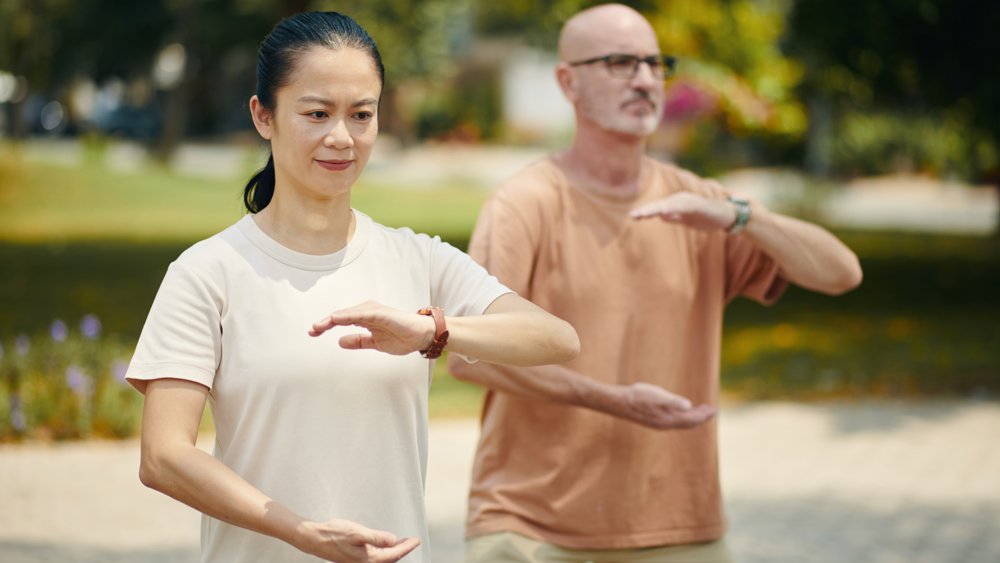
This is the largest family and the one most beginners want. Health Qigong is built to keep the body supple, calm the nervous system, and support everyday wellbeing. The movements are gentle, slow, and repeatable. You do not need strength or flexibility to begin, and you can scale any movement down to what your body allows today. Medical Qigong is a more specialized branch of this family, often practiced one-on-one with a trained practitioner for a specific concern. If you are here to feel steadier, sleep better, or carry less tension, this is your family. What the research does and does not support is worth reading honestly, and you can see the evidence roundup on our research page.
Spiritual Qigong
Spiritual Qigong grew out of Daoist and Buddhist practice, where movement and breath prepare you for stillness, meditation, and inner quiet. The aim is less about the body and more about presence and awareness. A lot of these forms are quiet, internal, and standing or seated. This family overlaps with meditation, and if that is the draw for you, our piece on Qigong versus meditation walks through how the two practices meet.
Martial Qigong
Martial Qigong is the training that supports the internal martial arts, Tai Chi and Bagua among them. Here the energy work builds rooted stance, structural power, and focus for the fighting arts. Standing practice belongs partly here too, because a strong, quiet stance is the ground the martial arts are built on. Most beginners drawn to Qigong for health will never need this branch, and that is fine. It helps to know it exists so the martial-sounding forms you see online make sense.
Named beginner forms worth knowing
Underneath those three families sit named forms, the set routines that get taught by name. You will meet these three again and again as a beginner, and any one of them is a solid start.
Ba Duan Jin, the Eight Brocades
Ba Duan Jin translates as the Eight Pieces of Brocade, sometimes the Eight Silken Movements. It is eight gentle movements done in order, each one working a different part of the body and breath. It is one of the oldest and most widely taught health sets in the world, and it is popular with beginners for a simple reason: it is short, it has a clear order, and it is easy to remember. You can learn it a movement at a time and have the whole form inside a couple of weeks.
Wu Qin Xi, the Five Animals
Wu Qin Xi, the Five Animal Frolics, is another classic health set, credited to the physician Hua Tuo nearly two thousand years ago. You move in the spirit of five animals, the crane, the bear, the monkey, the deer, and the tiger, each one drawing out a different quality in the body. It is a little more expressive and playful than the Eight Brocades, which some people love and others find is more choreography than they want at the very start.
Zhan Zhuang, standing practice
Zhan Zhuang means standing like a post. There is no choreography at all. You stand in a relaxed, grounded posture and let the body settle while the breath slows. It looks like doing nothing and it is quietly demanding, in the best way. Because there are no steps to memorize, it is one of the cleanest possible beginnings, and it teaches the rooted, present quality that runs underneath every other style. We cover it on its own in our guide to standing Qigong, Zhan Zhuang.
Everything is Qigong. Journaling is Qigong. Going for a walk in the woods is Qigong. Taking a nap is Qigong. Christopher Grant
Which one should you start with?
Here is the honest answer. The best style is the one you will actually practice, and the differences between the gentle health styles matter far less than showing up. If you want structure and a sense of progress, start with Ba Duan Jin. If choreography stresses you out, start with Zhan Zhuang, where you simply stand and breathe. If you want something playful, the Five Animals will suit you.
You do not have to marry the first one you try. Most people who stay with Qigong end up touching several styles over the years, and each one teaches the same core skill from a slightly different angle. Pick a gentle door, walk through it, and let the practice sort the rest out. When you are ready to build a first routine of your own, our Qigong exercises for beginners gives you movements you can string together today.
Common questions
How many types of Qigong are there?
There are hundreds of named styles, and no one has a definitive count. They fall into three broad families: health and medical Qigong for wellbeing, spiritual Qigong for meditation and stillness, and martial Qigong that supports the internal martial arts. As a beginner you only need one gentle health style to start.
Which type of Qigong is best for beginners?
A gentle health style is the usual first door. Ba Duan Jin, the Eight Brocades, is a common starting form because it is short, ordered, and easy to remember. Standing practice, Zhan Zhuang, is another simple beginning that needs no choreography at all.
Three broad families of Qigong
| Family | What it emphasizes | Example |
|---|---|---|
| Health and medical | Gentle healing, circulation, and calm | Our Healing Qigong |
| Martial | Structure, power, and rootedness | Iron Shirt, hard Qigong |
| Spiritual and meditative | Stillness and inner cultivation | Inner alchemy, standing meditation |
This article is educational and general in nature, not medical advice. Qigong is not a treatment or cure for any condition. If you have a health concern, are pregnant, or are managing an injury, check with your own practitioner before starting a new practice.